Performance
Here, as anticipated in the introduction page of the benchmarks, we will track the runtime of emu-sv by comparing runs on GPU vs CPU, and CPU vs pulser-simulation (which is cpu only).
Adiabatic sequence
We run an adiabatic sequence to make an antiferromagnetic (AFM) state, as taken from one of our tutorials, for a line of atoms. In contrast to emu-mps, the performance of emu-sv does not depend on the type of sequence, other than through its duration, so there is no real benefit to showing results for the adiabatic and the quench sequence separately.
First, let us compare emu-sv with pulser:
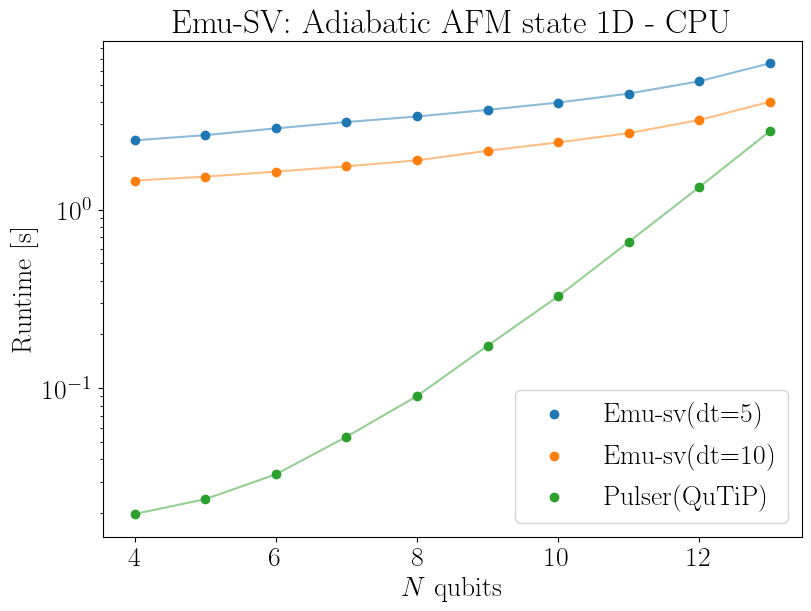
Runtimes are shown for two different values of dt which shows that halving dt almost doubles the runtime. Halving dt doubles the number of timesteps taken by the program, but the algorithm for computing a single timestep converges faster, leading to a sublinear scaling of the runtime in terms of the number of timesteps. For the values of dt in the plot, extending the graphs shows that emu-sv outperforms pulser in runtime at 14 qubits and onwards.
Next, let us compare runs of emu-sv between CPU and GPU:
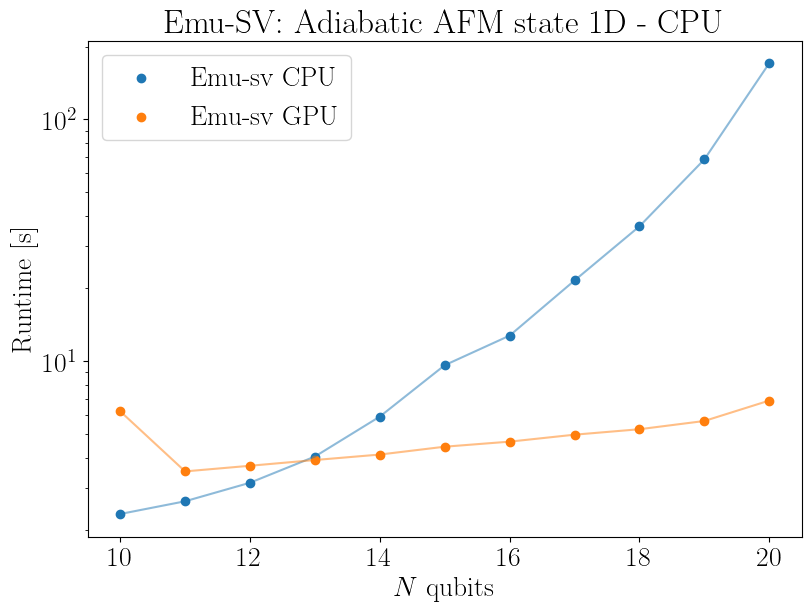
There is a marginal runtime difference between CPU and GPU for smaller qubit numbers, which is mostly coincidental, since neither hardware is saturated with computations yet, and exponential scaling of the runtime has not yet set in. When comparing the runtimes between 19 and 20 qubits, they can be seen to roughly double for CPU, as expected by exponential scaling. For GPU, this exponential scaling has not yet set in even at 20 qubits. This shows that the computational resources of the GPU are not yet fully saturated and performance improvement is possible. Nevertheless, at 20 qubits, running emu-sv on GPU already reduces the runtime by about 25 times.